
 By Asfand Yar Khan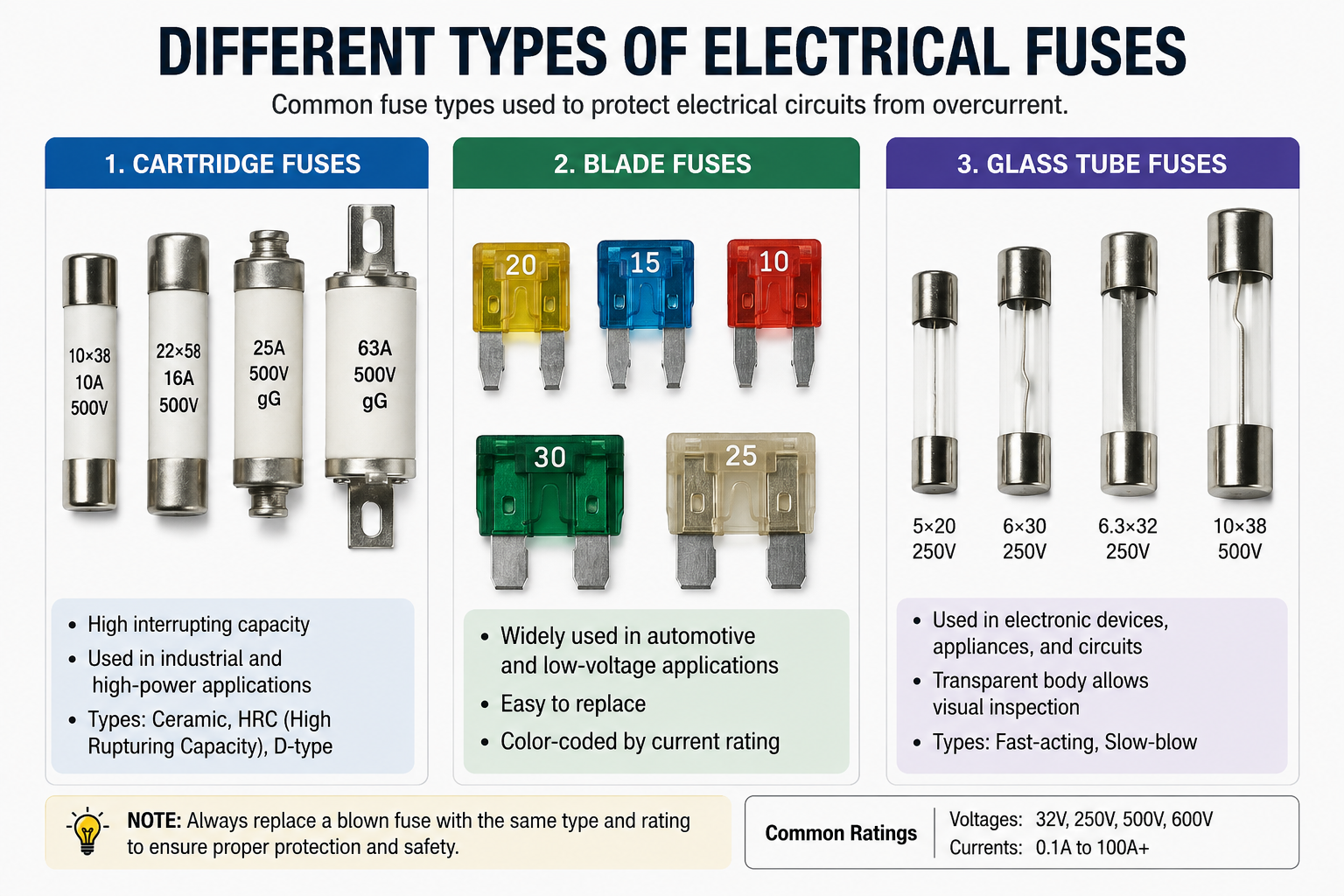
Electrical fuses are the unsung heroes of electrical safety, quietly protecting your home, vehicle, and electronic devices from potentially catastrophic electrical failures. Whether you’re troubleshooting a blown fuse in your car, upgrading an old residential fuse box, or selecting components for an industrial application, understanding electrical fuses is essential for safety and reliability.
This comprehensive guide covers everything you need to know about electrical fuses—from how they work and the different types available, to reading ratings, proper selection, and safe replacement procedures.
Table of Contents
- What Is an Electrical Fuse?
- Types of Electrical Fuses
- Understanding Fuse Ratings and Specifications
- Electrical Fuse Symbols and Markings
- Common Applications of Electrical Fuses
- How to Choose the Right Electrical Fuse
- Signs Your Electrical Fuse Needs Replacement
- How to Replace an Electrical Fuse Safely
- Common Electrical Fuse Problems and Solutions
- Frequently Asked Questions
What Is an Electrical Fuse?
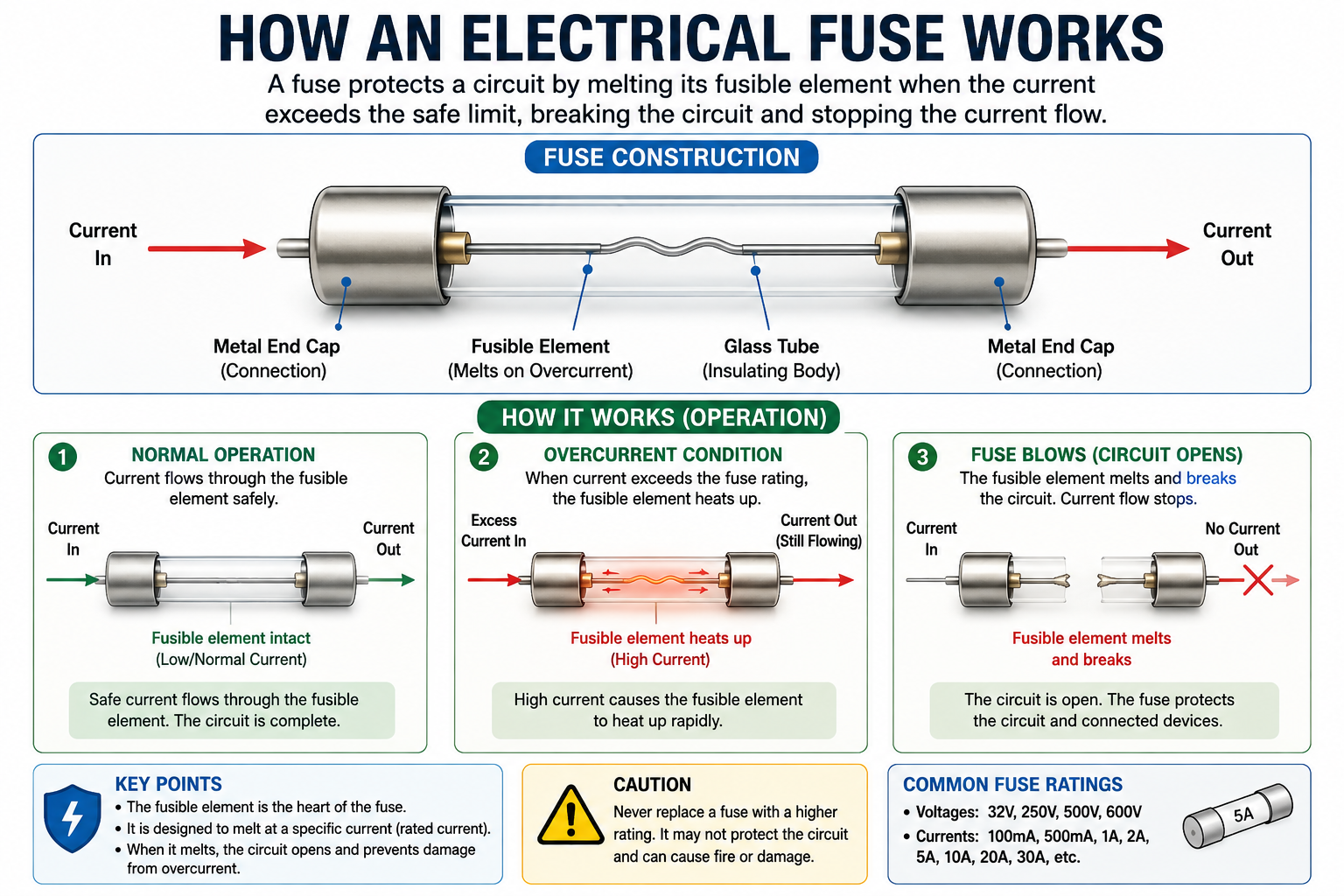
An electrical fuse is a sacrificial overcurrent protection device designed to protect electrical circuits and equipment from damage caused by excessive current flow. When current exceeds the fuse’s rating, a metallic element inside the fuse melts, breaking the circuit and stopping the flow of electricity.
Fuses serve as the weakest link in an electrical system—by design. This intentional weak point prevents more expensive components, wiring, or entire buildings from damage or fire when electrical faults occur.
How Does an Electrical Fuse Work?
The basic operating principle of an electrical fuse is elegantly simple:
- Normal Operation: Electric current flows through a thin metal wire or strip (the fusible element) inside the fuse body
- Overcurrent Condition: When current exceeds the fuse’s rating due to overload or short circuit, the fusible element heats up rapidly
- Melting Point: The element reaches its melting temperature and liquefies
- Circuit Interruption: The melted gap in the element breaks the electrical path, stopping current flow
- Protection Achieved: The circuit is now open, protecting downstream components and wiring
The fusible element is typically made from materials like zinc, copper, silver, aluminum, or alloys designed to melt at specific temperatures corresponding to precise current levels. Some fuses contain arc-quenching materials like sand or special gases to safely extinguish the electrical arc that forms when the element melts.
Fuse vs. Circuit Breaker: Key Differences
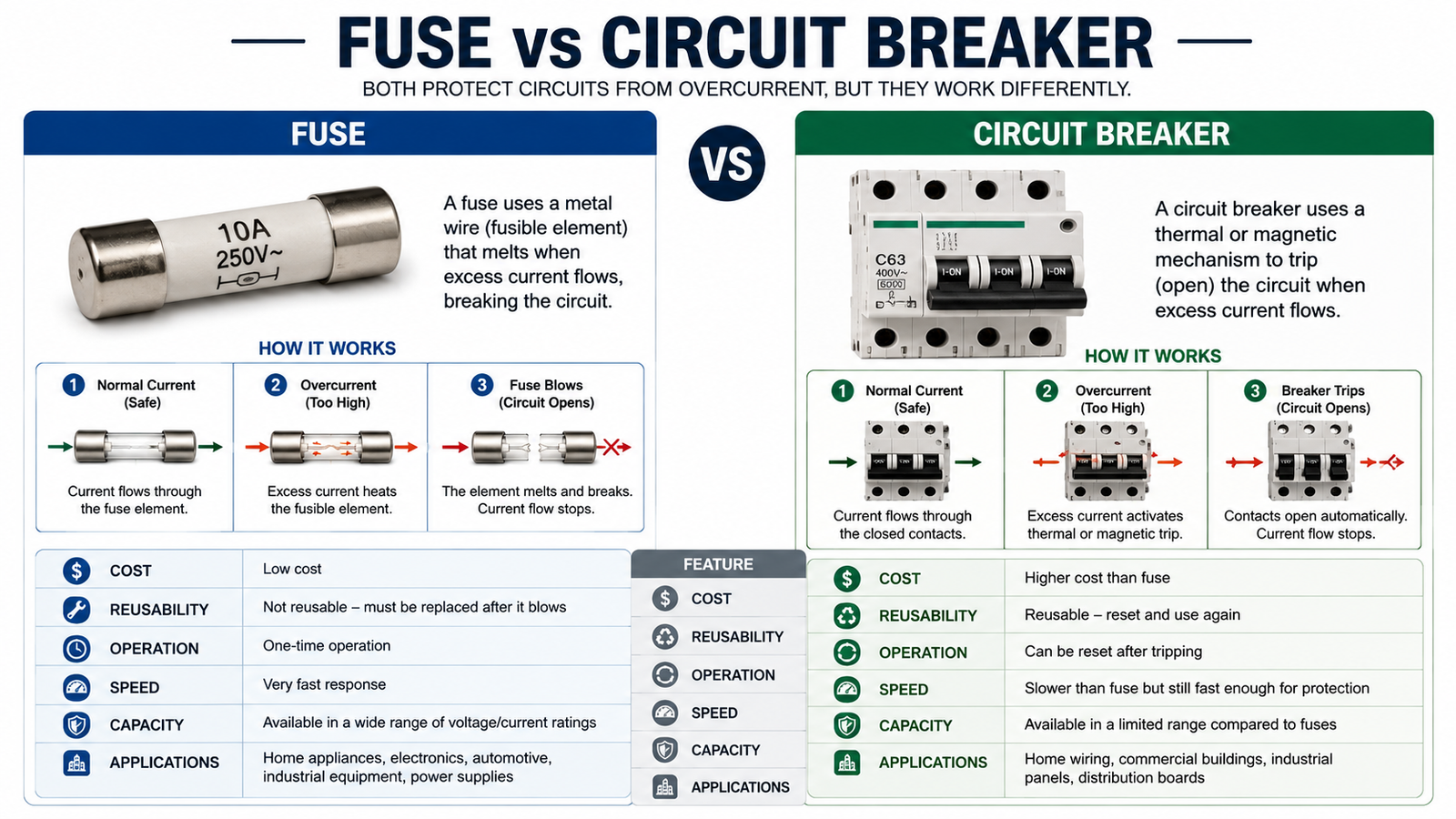
While both fuses and circuit breakers provide overcurrent protection, they operate differently and each has distinct advantages:
Electrical Fuses:
- Single-use devices that must be replaced after activation
- Extremely fast response time (milliseconds)
- Lower initial cost
- No moving parts to wear out
- More precise current-limiting characteristics
- Ideal for sensitive electronic equipment
- Require inventory of replacement fuses
- SEE ALSO
Circuit Breakers:
- Reusable devices that can be reset after tripping
- Slightly slower response time
- Higher initial cost but lower long-term expense
- Mechanical components that can eventually fail
- More convenient for frequently tripped circuits
- No need to keep replacements on hand
- Better for easy troubleshooting and testing
In older homes, you might still find a fuse box rather than a modern circuit breaker panel. Many industrial applications still prefer fuses for their superior current-limiting ability and reliability.
Types of Electrical Fuses
Electrical fuses come in numerous types, each designed for specific applications, voltage levels, and current ratings. Understanding these differences helps you select the right fuse for your needs.
1. Cartridge Fuses
Cartridge fuses are cylindrical fuses with metal contact points at each end. They’re commonly used in residential electrical panels, industrial equipment, and appliances.
Subcategories:
- Ferrule-type cartridge fuses: Have rounded ends, typically rated up to 60 amps
- Knife-blade cartridge fuses: Have flat blade contacts, used for higher amperage (70-600 amps)
- Time-delay cartridge fuses: Can withstand temporary current surges (ideal for motors)
- Fast-acting cartridge fuses: Blow quickly to protect sensitive electronics
Cartridge fuses are rated by voltage (typically 250V or 600V) and current capacity. They’re more reliable than plug fuses and less prone to tampering.
2. Plug Fuses (Edison Base & Type S)
Plug fuses screw into a fuse socket similar to a light bulb and are found in older residential fuse boxes.
Edison Base Fuses:
- Screw-in design with standard Edison (light bulb) threads
- Rated for 125 volts
- Available in 15, 20, 25, and 30-amp ratings
- Problem: Can be dangerously replaced with wrong amp rating
Type S Fuses (Tamper-Proof):
- Require an adapter specific to each amp rating
- Once the adapter is installed, only the correct amp fuse can be used
- Prevents the dangerous practice of “over-fusing”
- Now required by electrical code in many jurisdictions
Plug fuses typically have a small window allowing visual inspection of the fusible element.
3. Blade Fuses (Automotive)
Blade fuses, also called spade or plug-in fuses, are the standard in automotive applications but also appear in some low-voltage DC systems.
Common Types:
- Mini blade fuses: Compact design for modern vehicles
- Standard (ATO/ATC) blade fuses: Most common automotive fuse
- Maxi blade fuses: Larger, for high-current applications (30-80 amps)
- Low-profile mini blade fuses: Even more compact than mini
Blade fuses use color coding for easy amp identification:
- Brown (5A), Red (10A), Blue (15A), Yellow (20A), Clear (25A), Green (30A)
4. Glass Tube Fuses
Glass tube fuses are small cylindrical fuses with metal caps and a visible fusible wire inside a glass tube. They’re common in electronics, appliances, and older electrical equipment.
Characteristics:
- Standard sizes: 3AG, 5AG, 8AG (varies by length and diameter)
- Transparent body allows visual inspection
- Fast-acting or time-delay varieties available
- Typically rated 32V to 250V, 1/16A to 30A
- Fragile and can break if dropped
These fuses are found in everything from Christmas lights to power supplies and test equipment.
5. Thermal Fuses
Thermal fuses (thermal cutoffs) respond to temperature rather than current. They’re one-time temperature-sensitive devices that open when they reach a specific temperature.
Applications:
- Hair dryers and curling irons
- Coffee makers and electric kettles
- Space heaters
- Transformers and motors
- Any appliance where overheating is a fire risk
Once activated, thermal fuses cannot be reset and must be replaced. They typically have temperature ratings from 70°C to 240°C.
6. Resettable Fuses (PPTC)
Polymeric Positive Temperature Coefficient (PPTC) devices, often called resettable fuses or polyfuses, automatically reset after the fault condition is removed.
How They Work:
- Made from conductive polymer that increases resistance when heated
- Overcurrent causes heating and dramatic resistance increase
- Circuit is effectively opened (very high resistance state)
- When current is removed and device cools, resistance returns to normal
- Can be “tripped” and reset thousands of times
Applications:
- USB ports and computer peripherals
- Telecommunications equipment
- Battery packs
- Automotive electronics
- Consumer electronics
These aren’t true fuses but serve a similar protective function with the advantage of automatic recovery.
Understanding Fuse Ratings and Specifications
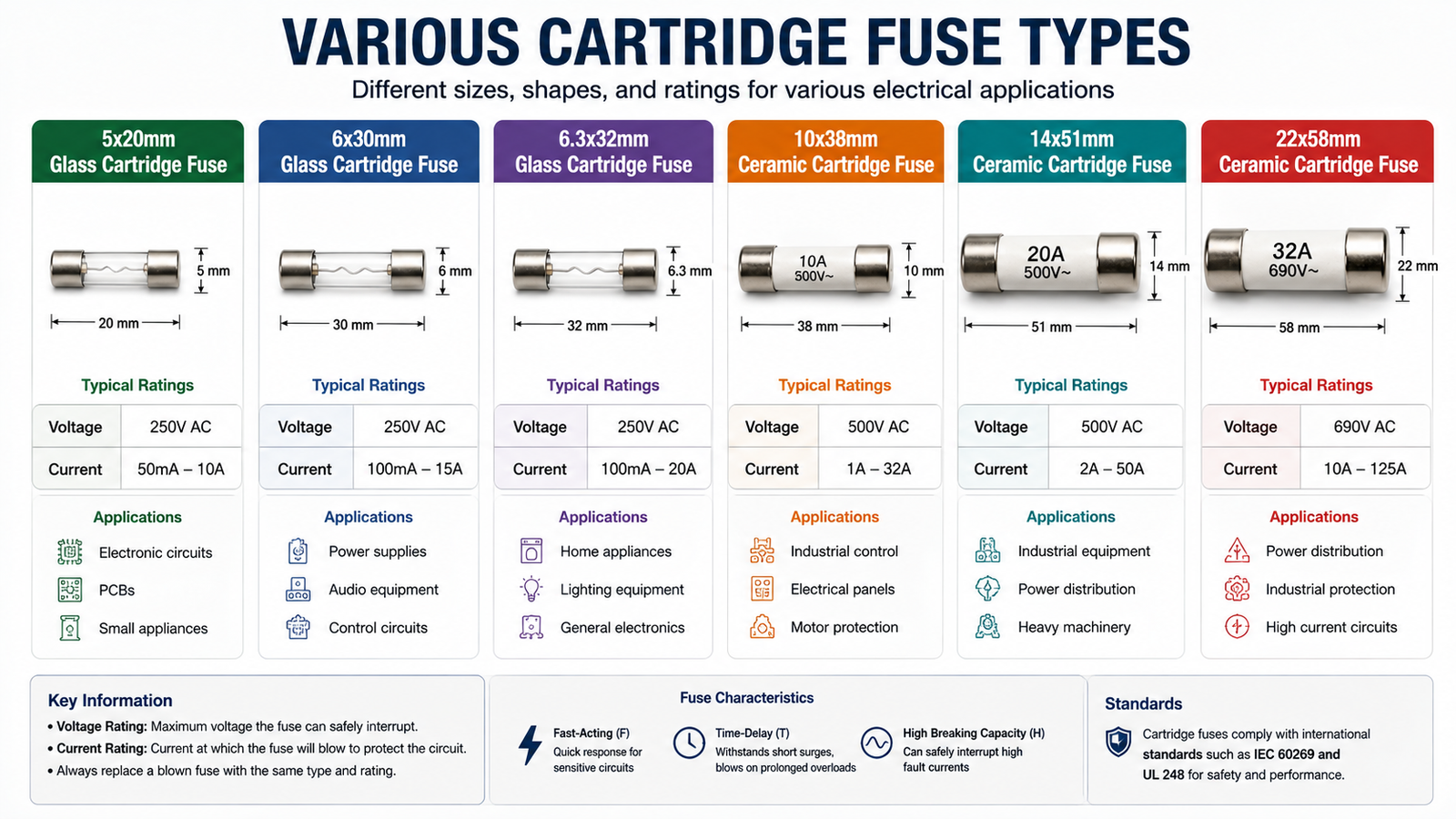
Selecting the correct fuse requires understanding several key specifications marked on the fuse body. Using a fuse with incorrect ratings can result in inadequate protection or nuisance blowing.
Voltage Rating Explained
The voltage rating indicates the maximum voltage at which the fuse can safely interrupt (open) a circuit. This is critical for arc suppression.
Key Points:
- You can use a fuse with a higher voltage rating than your circuit voltage
- Never use a fuse with a lower voltage rating than your circuit
- Common ratings: 32V, 125V, 250V, 600V
- AC and DC ratings may differ (DC is harder to interrupt)
For example, a 250V fuse can safely be used in a 120V circuit, but a 125V fuse should not be used in a 240V circuit.
Current (Amp) Rating Guide
The current rating (or amperage) indicates the maximum continuous current the fuse can carry without blowing.
Selection Guidelines:
- The fuse should be rated at or slightly above the normal operating current
- Must be below the current-carrying capacity of the wiring
- Account for inrush currents in motor and transformer circuits
- Consider ambient temperature (high temperatures may require derating)
Common residential ratings:
- 15A: Standard lighting and outlet circuits
- 20A: Kitchen outlets, bathroom outlets, some appliances
- 30A: Electric dryers, air conditioners
- 40-50A: Electric ranges and large appliances
Breaking Capacity (Interrupt Rating)
The breaking capacity, also called the interrupt rating, indicates the maximum fault current the fuse can safely interrupt without rupturing or creating a hazard.
Expressed in amperes (often thousands of amps), this rating ensures the fuse can handle short circuit conditions:
- 10kA (10,000A): Adequate for most residential applications
- 100kA or 200kA: Required for commercial and industrial installations
Always verify that the fuse’s interrupt rating exceeds the available fault current at its installation point.
Time-Current Characteristics
Fuses are classified by how quickly they respond to overcurrent conditions:
Fast-Acting (F):
- Blow quickly with minimal overcurrent
- Protect sensitive electronics and semiconductor circuits
- Not suitable for circuits with inrush currents
Time-Delay / Slow-Blow (T):
- Tolerate temporary overcurrent surges
- Ideal for motors, transformers, and inductive loads
- Allow startup currents without nuisance blowing
- Still protect against sustained overloads and short circuits
Medium Time-Lag:
- Intermediate characteristics between fast and slow
- General-purpose applications
The time-current curve shows exactly how long a fuse takes to blow at various current levels—essential data for critical applications.
Electrical Fuse Symbols and Markings
Understanding fuse symbols and label markings helps you identify the correct replacement and understand the fuse’s characteristics.
IEC Fuse Symbols
International standards use specific letter codes to identify fuse characteristics:
First Letter (Breaking Range):
- g (gG or gL): Full-range breaking capacity (general purpose)
- a (aM): Partial-range (protects against short circuits, for motor protection)
Second Letter (Protected Equipment):
- G: General purpose (cables and general applications)
- L: Cables and general distribution
- M: Motor protection
- R: Semiconductors (very fast-acting)
- B: Mining applications
- Tr: Transformers
Examples:
- gG fuse: General-purpose fuse with full-range protection
- aM fuse: Motor protection fuse (handles motor starting currents)
- gR fuse: Semiconductor protection (ultra-fast)
How to Read Fuse Labels
A typical fuse label contains:
- Current Rating: The amp value (e.g., 10A, 15A, 20A)
- Voltage Rating: Maximum voltage (e.g., 250V, 600V)
- Interrupt Rating: Breaking capacity (e.g., 10kA, 100kA)
- Speed Designation: F (fast), T (time-delay), etc.
- Standards Certification: UL, CSA, IEC marks
- Manufacturer Part Number
Example Reading:
“T10A250V” = Time-delay, 10 amp, 250 volt fuse
Understanding these markings ensures you select an exact replacement that maintains the intended protection.
Common Applications of Electrical Fuses
Electrical fuses protect virtually every type of electrical system. Here are the most common applications:
Residential Electrical Panels
While modern homes use circuit breaker panels, millions of older homes still rely on fuse boxes for overcurrent protection.
Typical residential fuse panel features:
- Main fuse (60-100 amps) protecting the entire service
- Individual branch circuit fuses (15-30 amps) for different areas
- Plug fuses or cartridge fuses depending on age and amperage
- May include separate fuse blocks for large appliances
If you have a fuse box, consider upgrading to a circuit breaker panel for improved safety and convenience, especially if you’re planning electrical system upgrades.
Automotive Fuse Boxes
Every vehicle contains one or more fuse boxes protecting individual electrical circuits:
Under-hood fuse box:
- High-amperage maxi fuses for major systems
- Protects engine management, cooling fans, fuel pumps
- Often contains relays as well as fuses
Interior fuse panel:
- Standard and mini blade fuses for accessories
- Protects radio, power windows, interior lights, dashboard
- Usually located under the dashboard or in the glove box
Fuse location varies by make and model, but your owner’s manual includes a fuse diagram showing which fuse protects each circuit.
Industrial Equipment
Industrial settings use fuses extensively for equipment protection:
- Motor control centers: Time-delay fuses handle motor starting currents
- Transformers: Protect against internal faults and overloads
- Variable frequency drives (VFDs): Semiconductor fuses protect expensive power electronics
- Machinery and production equipment: Class CC, Class J, and other industrial-grade fuses
- Photovoltaic systems: DC-rated fuses for solar installations
Industral fuses often have exceptional interrupt ratings (100kA-200kA) to handle the high fault currents available in commercial electrical systems.
Electronic Devices and Appliances
Small fuses protect the internal components of electronic devices:
- Power supplies: Glass tube or surface-mount fuses
- Computer equipment: Often on the AC input section
- Televisions and audio equipment: Protection against component failure
- Kitchen appliances: Microwaves, coffee makers, toasters
- HVAC equipment: Furnaces, air handlers, thermostats
These fuses are typically lower amperage (milliamps to a few amps) and may require soldering to replace in some devices.
How to Choose the Right Electrical Fuse
Selecting the correct fuse involves matching several parameters to your application. Using the wrong fuse compromises safety.
Matching Voltage Requirements
Step 1: Determine your circuit voltage (AC or DC)
Step 2: Select a fuse with a voltage rating equal to or greater than the circuit voltage
Important considerations:
- AC and DC voltage ratings may differ on the same fuse
- DC circuits are harder to interrupt (require higher voltage rating)
- Never use a lower voltage-rated fuse than your circuit voltage
- Higher voltage rating than needed is safe and acceptable
Example: For a 120V AC circuit, you can use a 125V, 250V, or 600V rated fuse, but not a 32V fuse.
Calculating Required Amperage
Step 1: Determine the normal operating current of the circuit or device
For individual devices:
- Check the nameplate or specifications
- Note the wattage and voltage
- Calculate: Amps = Watts ÷ Volts
Example: A 1200W appliance on 120V draws 10 amps (1200÷120=10)
Step 2: Consider startup/inrush currents
- Motors and transformers draw much more current during startup
- Use time-delay fuses rated for 125-150% of running current
- Or consult manufacturer’s fuse recommendations
Step 3: Verify wire capacity
- The fuse must be rated at or below the wire’s ampacity
- Never use a fuse rated higher than the wire can safely carry
- Common residential wire: 14 AWG (15A max), 12 AWG (20A max), 10 AWG (30A max)
Stp 4: Select fuse amperage
- Should be at or slightly above normal operating current
- Must be below wire ampacity
- Must protect the device/circuit adequately
Selecting the Correct Fuse Type
Match the fuse type to your application:
Use fast-acting fuses for:
- Sensitive electronic circuits
- Semiconductor protection
- Circuits with no significant startup surge
Use time-delay fuses for:
- Electric motors
- Transformers
- Inductive loads
- Circuits with high inrush currents
- General lighting circuits with incandescent bulbs
the same physical type:
- Match the fuse holder/socket type
- Cartridge, blade, glass tube, etc.
- Ensure physical compatibility
Verify certifications:
- Look for UL, CSA, or equivalent safety certification
- Ensure the fuse meets applicable electrical codes
- Use quality fuses from reputable manufacturers
Signs Your Electrical Fuse Needs Replacement
Knowing when a fuse has blown—and identifying potential problems—helps maintain electrical safety and system reliability.
Visual Inspection Tips
Many fuses allow visual inspection without testing equipment:
For glass tube and plug fuses with windows:
- Broken filament: Clear indication the fuse has blown
- Discolored or clouded glass: Indicates the fuse blew due to severe overload or short circuit
- Clear glass with intact filament: Fuse is likely good (confirm with testing)
- Metallic deposit on glass interior: Resulted from vaporized fusible element
For all fuse types:
- Physical damage: Cracks, chips, or broken components mean replacement
- Corrosion: Green or white deposits on contacts indicate moisture exposure
- Discoloration: Burn marks or melted plastic suggest overheating
- Loose contacts: Fuse doesn’t fit snugly in holder
Warning signs that indicate potential problems:
- Repeated fuse failures in the same circuit
- Fuses that feel warm or hot to the touch during normal operation
- Burning smell near fuse panel
- Flickering lights or intermittent operation
Testing a Fuse with a Multimeter
For opaque fuses or confirmation of visual inspection:
Equipment needed:
- Digital multimeter or analog ohmmeter
- Safe working area with good lighting
Testing procedure:
Method 1: Continuity Test (fuse removed)
- Turn off power and remove the fuse
- Set multimeter to continuity mode (usually marked with a sound wave symbol)
- Touch probes to both ends of the fuse
- Good fuse: Multimeter beeps and shows near-zero resistance (typically <1 ohm)
- Blown fuse: No beep, display shows “OL” (open/infinite resistance)
Method 2: Resistance Test
- Remove fuse from circuit
- Set multimeter to resistance (ohms) mode
- Touch probes to both fuse ends
- Good fuse: Very low resistance (typically <1 ohm)
- Blown fuse: Infinite resistance (OL or ∞)
3: Voltage Test (in-circuit, advanced)
- Set multimeter to AC or DC voltage (match circuit type)
- With power on and load connected, measure voltage across fuse terminals
- Good fuse: Zero or near-zero voltage across fuse
- Blown fuse: Full circuit voltage appears across fuse
- Warning: Only experienced individuals should perform live circuit testing
Safety reminder: Always turn off power before removing or installing fuses unless you’re qualified to work on live circuits.
How to Replace an Electrical Fuse Safely
Replacing a fuse seems simple, but following proper safety procedures prevents electrical shock, arc flash, and equipment damage.
Safety Precautions
Before you begin:
- Turn off the main power if possible (especially for fuse panel work)
- Verify power is off using a voltage tester
- Stand on a dry surface and wear rubber-soled shoes
- Remove jewelry and metal watchbands
- Use insulated tools when available
- Never work alone when dealing with main electrical panels
- Have proper lighting – use a flashlight, not an extension light
- Keep fire extinguisher nearby (Class C rated for electrical fires)
- Never replace a fuse with a higher amperage rating
- Never use makeshift fuses (pennies, wire, aluminum foil—extremely dangerous)
For automotive fuses:
- Disconnect battery if replacing main fuses
- Use fuse puller tool to avoid breaking fuse
- Ensure ignition is off
Step-by-Step Replacement Guide
For Cartridge Fuses:
- Turn off main power at the service disconnect or meter
- Verify power is off using a non-contact voltage tester
- Locate the blown fuse (may require testing each one)
- Grasp the fuse firmly at both ends
- Pull straight out with steady pressure (may require significant force)
- Inspect fuse holder for damage, corrosion, or burning
- Select correct replacement matching amp and voltage ratings exactly
- Insert new fuse ensuring it’s fully seated in both clips
- Restore power and test the circuit
- Monitor the circuit for proper operation
Fr Plug Fuses (Edison Base or Type S):
- Turn off main power if possible
- Confirm the blown fuse (look through window at filament)
- Unscrew counterclockwise like a light bulb
- Check the fuse socket for corrosion or damage
- Verify correct replacement (check amp rating carefully)
- For Type S: Ensure adapter is installed for correct amperage
- Screw in new fuse clockwise until snug (don’t overtighten)
- Restore power and verify operation
For Blade Fuses (Automotive):
- Turn off ignition and remove key
- Locate fuse panel (consult owner’s manual)
- Identify the correct fuse using the fuse diagram
- Use fuse puller tool or needle-nose pliers to remove fuse
- Check fuse visually for broken element
- Match replacement to the exact amp rating and color
- Insert new fuse until it clicks into place
- Test the circuit (turn on the affected accessory)
F0r Glass Tube Fuses:
- Unplug the device or turn off power
- Locate fuse holder (may require removing cover)
- Remove blown fuse (may unscrew or pull out depending on holder type)
- Match replacement exactly (same size, amperage, and voltage)
- Insert new fuse ensuring proper seating
- Reassemble and test
After replacement:
- If the fuse blows immediately or repeatedly, you have an electrical problem
- Don’t keep replacing fuses—investigate the root cause
- Consult a licensed electrician for persistent fuse problems
Common Electrical Fuse Problems and Solutions
When fuses blow repeatedly or circuits don’t work despite good fuses, troubleshooting identifies the underlying issue.
Fuses Blowing Repeatedly
Possible Causes:
1. Circuit Overload
- Too many devices on one circuit
- Device drawing more current than rated capacity
- Solution: Reduce load, redistribute devices to other circuits, or install dedicated circuit for high-draw appliance
2. Short Circuit
- Damaged wire insulation causing wires to touch
- Faulty appliance or device
- Rodent damage to wiring
- Solution: Disconnect devices one at a time to isolate problem; inspect wiring; repair or replace damaged components
3. Ground Fault
- Hot wire touching ground or metal box
- Moisture in electrical box
- Damaged tool or appliance cord
- Solution: Inspect connections, ensure proper grounding, address moisture issues, replace damaged cords
4. Faulty Fuse Holder
- Loose connections causing arcing and heat
- Corrosion increasing resistance
- Solution: Clean contacts with contact cleaner; tighten connections; replace damaged holders
5. Wrong Fuse Type
- Fast-acting fuse on motor circuit
- Underrated fuse for application
- Solution: Install correct fuse type (time-delay for inductive loads)
6. Aging or Defective Fuses
- Old fuses can become sensitive and blow prematurely
- Counterfeit or substandard fuses
- Solution: Replace with quality fuses from reputable suppliers
Wrong Fuse Installed
Installing the wrong fuse is dangerous and common:
Over-fused Circuit (too high amperage):
- Danger: Wires can overheat before fuse blows, causing fire risk
- How it happens: Previous owner/installer used wrong fuse; gradual increasing of fuse size to stop “nuisance” blowing
- Solution: Install correct amp-rated fuse immediately; investigate why previous fuse was blowing
Under-fused Circuit (too low amperage):
- Danger: Nuisance blowing; reduced circuit capacity
- How it happens: Incorrect replacement; time-delay fuse replaced with fast-acting
- Solution: Install proper fuse for load and wire capacity
Wrong Voltage Rating:
- Danger: Fuse may not safely interrupt fault current, causing arc flash or explosion
- Solution: Verify voltage rating matches or exceeds circuit voltage
Wrong Physical Type:
- Danger: Poor contact, overheating, falling out
- Solution: Use only the correct fuse type for the holder
Corrosion and Poor Connections
Corrosion at fuse contacts increases resistance, causing overheating without overcurrent:
Symptoms:
- Warm or hot fuse during normal operation
- Flickering lights or intermittent operation
- Discoloration around fuse contacts
- Green or white corrosion deposits
Causes:
- Moisture in fuse panel
- Dissimilar metals causing galvanic corrosion
- Poor initial installation
- Environmental exposure (especially in basements, garages)
Solutions:
- Turn off power
- Remove fuse and inspect holder
- Clean contacts with electrical contact cleaner or fine sandpaper
- Apply dielectric grease to contacts to prevent future corrosion
- Ensure tight fit – replace spring clips if loose
- Address moisture source if applicable
- Consider upgrading to circuit breaker panel if corrosion is widespread
Prevention:
- Keep fuse panels dry
- Ensure proper ventilation
- Use corrosion-inhibiting compounds
- Perform periodic inspection and maintenance
Frequently Asked Questions About Electrical Fuses
Q: What is an electrical fuse?
A: An electrical fuse is a safety device that protects electrical circuits from overcurrent and short circuits. It contains a metal wire or strip that melts when too much current flows through it, breaking the circuit and preventing damage or fire.
Q: How do I know what amp fuse I need?
A: Check the amperage rating of the circuit or device you’re protecting. The fuse should be rated slightly higher than the normal operating current but lower than the wire’s maximum capacity. For example, a 15-amp circuit typically uses a 15-amp fuse. For devices, consult the manufacturer’s specifications or nameplate.
Q: Can I replace a fuse with a higher amp rating?
A: No, never replace a fuse with a higher amp rating. This defeats the safety purpose and can cause electrical fires, equipment damage, or electrical shock. Always use the exact amp rating specified for the circuit or device. If a fuse blows repeatedly, you have an electrical problem that needs diagnosis, not a larger fuse.
Q: What causes a fuse to blow?
A: Fuses blow due to circuit overload (too many devices or one high-draw device), short circuits (wires touching each other), ground faults (hot wire touching ground), or faulty equipment drawing excessive current. A fuse blowing repeatedly indicates an underlying electrical problem that needs professional diagnosis.
Frequently Asked Questions
Q: Can you reset an electrical fuse?
A: Traditional fuses cannot be reset—they must be replaced after blowing. However, resettable fuses (polymeric positive temperature coefficient or PPTC devices) automatically reset after the overcurrent condition is removed and the device cools down. These are found in some modern electronics but are not true fuses in the traditional sense.
Q: What’s the difference between a fuse and a circuit breaker?
A: Fuses are single-use devices that must be replaced after activation, while circuit breakers can be reset and reused. Fuses respond faster to overcurrent conditions and have superior current-limiting characteristics, but circuit breakers are more convenient for homeowners. Fuses are less expensive initially but require keeping replacements on hand. Circuit breakers cost more but eliminate replacement needs.
Q: How do you test if a fuse is blown?
A: Visually inspect glass or windowed fuses for a broken metal strip or darkened glass. For confirmation or opaque fuses, use a multimeter set to continuity or resistance mode—a good fuse shows continuity (beep or near-zero resistance), while a blown fuse shows infinite resistance (open circuit). Always remove the fuse from the circuit and turn off power before testing.
Q: Why does my automotive fuse keep blowing?
A: Common causes include short circuits in wiring, faulty accessories or components, damaged wiring harness (often from rodents), aftermarket installations with improper wiring, moisture in connectors, or a failing alternator. Disconnect accessories one at a time to isolate the problem, or consult a qualified automotive electrician for diagnosis.
Q: Are all glass fuses the same?
A: No. Glass tube fuses vary by physical size (3AG, 5AG, 8AG, etc.), voltage rating (32V to 250V), current rating (milliamps to 30+ amps), and time-delay characteristics (fast-acting vs. slow-blow). Always match all specifications when replacing glass fuses, not just the physical size.
Conclusion
Electrical fuses remain essential safety devices in homes, vehicles, industrial facilities, and electronic equipment worldwide. Understanding how they work, selecting the correct type and rating, and replacing them safely protects both people and property from electrical hazards.
Key Takeaways:
✓ Never compromise on fuse ratings – always match amperage, voltage, and type exactly
✓ Investigate repeated failures – fuses blowing repeatedly indicate underlying problems
✓ Upgrade when appropriate – consider replacing old fuse panels with modern circuit breakers
✓ Prioritize safety – turn off power, use proper tools, and call professionals when uncertain
✓ Keep proper replacements on hand – maintain an inventory of common fuse types you use
✓ Regular inspection – check fuse panels periodically for corrosion, damage, and proper operation
While circuit breakers have replaced fuses in many modern applications, fuses continue to offer advantages in response time, current-limiting capability, and cost-effectiveness for specific applications. Whether you’re maintaining an older home, troubleshooting automotive electrical systems, or designing industrial control circuits, proper fuse selection and installation remains critical.
When to Call a Professional:
- Fuses blow repeatedly despite troubleshooting efforts
- You smell burning or see signs of overheating
- You’re unsure about proper fuse selection or installation
- Your electrical panel shows signs of age or damage
- You’re considering upgrading from a fuse box to circuit breakers
- Any situation where you feel uncomfortable or unsafe
Electrical work can be dangerous. When in doubt, always consult a licensed electrician.